
Search Delaware Bankruptcy Records
Delaware bankruptcy records come from the U.S. Bankruptcy Court for the District of Delaware in Wilmington. This is the one court that handles every bankruptcy case filed by people and firms in the state. You can search Delaware bankruptcy records through PACER, the CM/ECF system, or by going to the court in person at 824 N. Market Street. The court serves all three counties: New Castle, Kent, and Sussex. This page shows how to look up cases, pull docket reports, get copies of filings, and find help with your search.
Delaware Bankruptcy Records Overview
About Delaware Bankruptcy Records
Delaware bankruptcy records are kept by the federal court, not by state or county offices. The U.S. Bankruptcy Court for the District of Delaware is the one court with power to hear these cases. It sits in Wilmington and covers all of the state. People from New Castle, Kent, and Sussex file here. Firms from across the country file here too, since Delaware is a top pick for large Chapter 11 cases.
Under 11 U.S.C. § 107, most bankruptcy records are public. You can see the debtor's name, case number, chapter, filing date, list of creditors, amounts owed, and the judge on the case. You can view the trustee and the debtor's lawyer. Most court papers are open. Some personal data, like full Social Security numbers, gets redacted to protect the filer.
Delaware bankruptcy records sit in the CM/ECF system. That system is the court's online file room. Cases filed since 2002 are in the system. Older cases may be stored off site at the National Archives in Philadelphia. To reach the court, call 302-252-2900 or email helpdeskde@deb.uscourts.gov. The help desk is open 8:00 am to 5:00 pm, Monday through Friday.
The U.S. Bankruptcy Court website is the best place to start. It hosts court news, forms, local rules, and judge pages in one spot. Visit the site to see hearing dates and chambers rules.
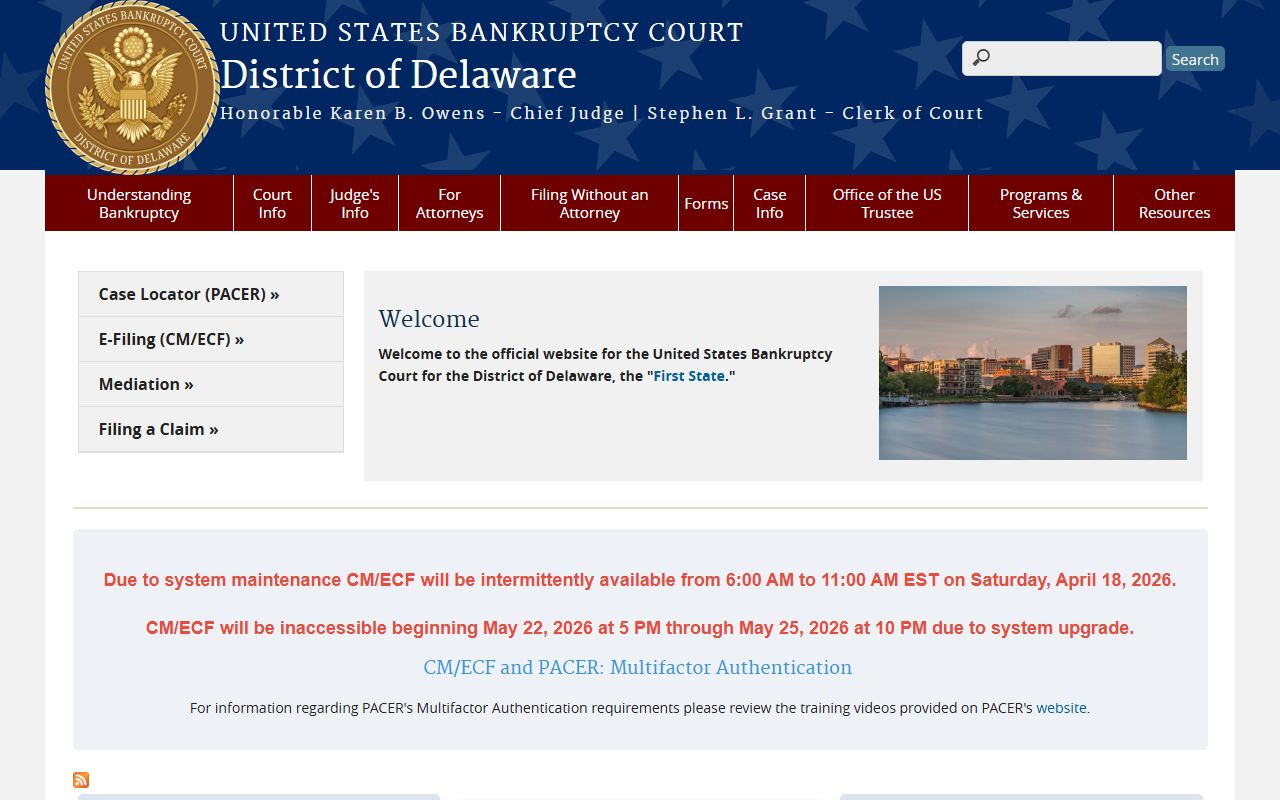
The homepage links out to CM/ECF, fee info, judges, and closed case help. Use it as your main door into Delaware bankruptcy records.
U.S. Bankruptcy Court District of Delaware
The court is at 824 N. Market Street, 3rd Floor, Wilmington, DE 19801. This is inside the J. Caleb Boggs Federal Building. You need a valid photo ID to enter. The clerk's office is on the 3rd floor. The main line is 302-252-2900. The help desk is 302-252-2887.
The court serves all of Delaware. It is one of the busiest bankruptcy courts in the country. Many large firms from other states file Chapter 11 cases here. That is because Delaware is the state where many U.S. firms are set up. Big cases filed here have included FTX Trading Ltd., Aerofarms, and many more. The court is well known for its work on complex corporate cases.
The Delaware State Courts FAQ explains that bankruptcy is a federal matter. State courts do not handle bankruptcy cases at all. To learn more, see the Delaware Courts general FAQ page.
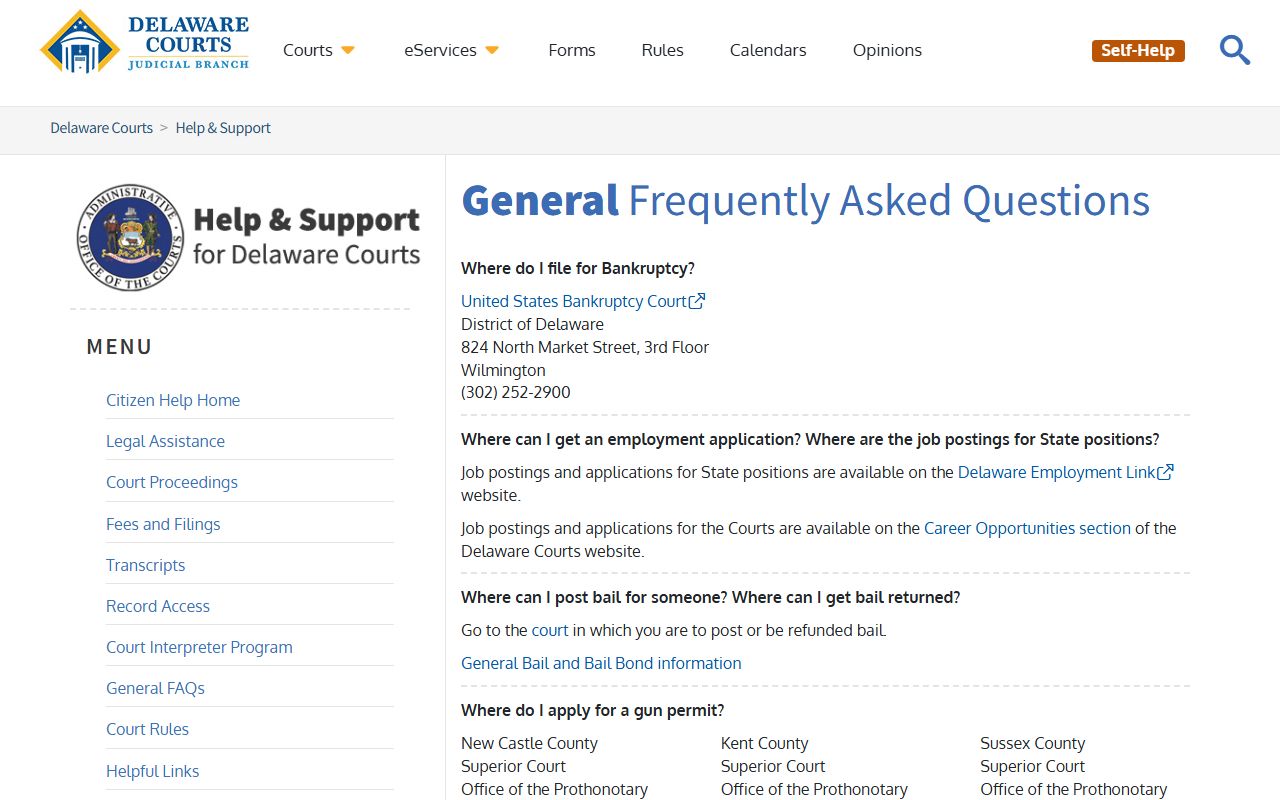
This page points all Delaware filers to the Wilmington court. It is the only lawful place to file.
Search Delaware Bankruptcy Records Online
PACER is the main online tool for Delaware bankruptcy records. PACER stands for Public Access to Court Electronic Records. You need a free account to sign in. Once you have one, you can search cases filed in Delaware and in every other federal court. Fees are $0.10 per page with a $3.00 cap per document. You can pull up dockets, motions, orders, and most filings. To make an account, go to pacer.uscourts.gov or call 800-676-6856.
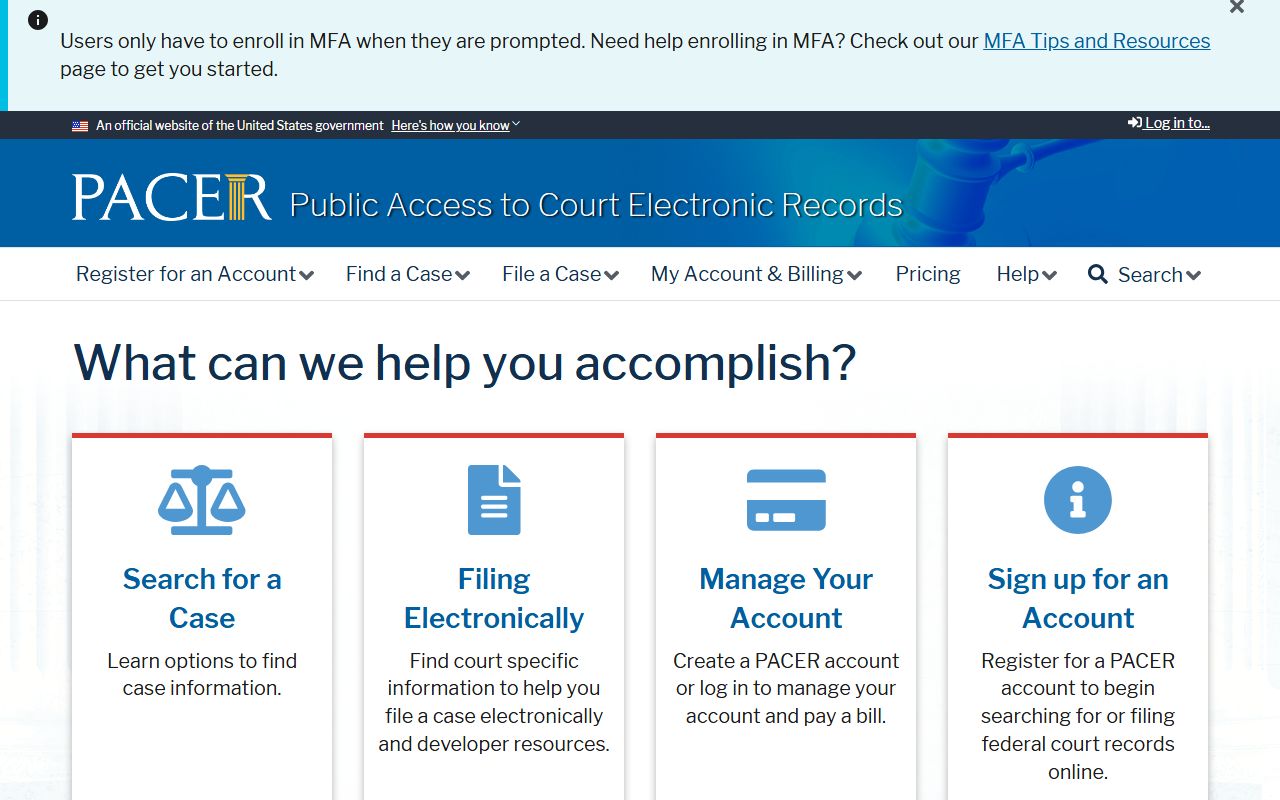
The PACER home page has sign-in, tools, and help links. Fees are waived if your annual use stays low.
If you do not know where a case was filed, use the PACER Case Locator. This tool covers every federal district, bankruptcy, and appellate court. You can search by party name, case number, or SSN. You can save cases and save searches. Start at pcl.uscourts.gov.
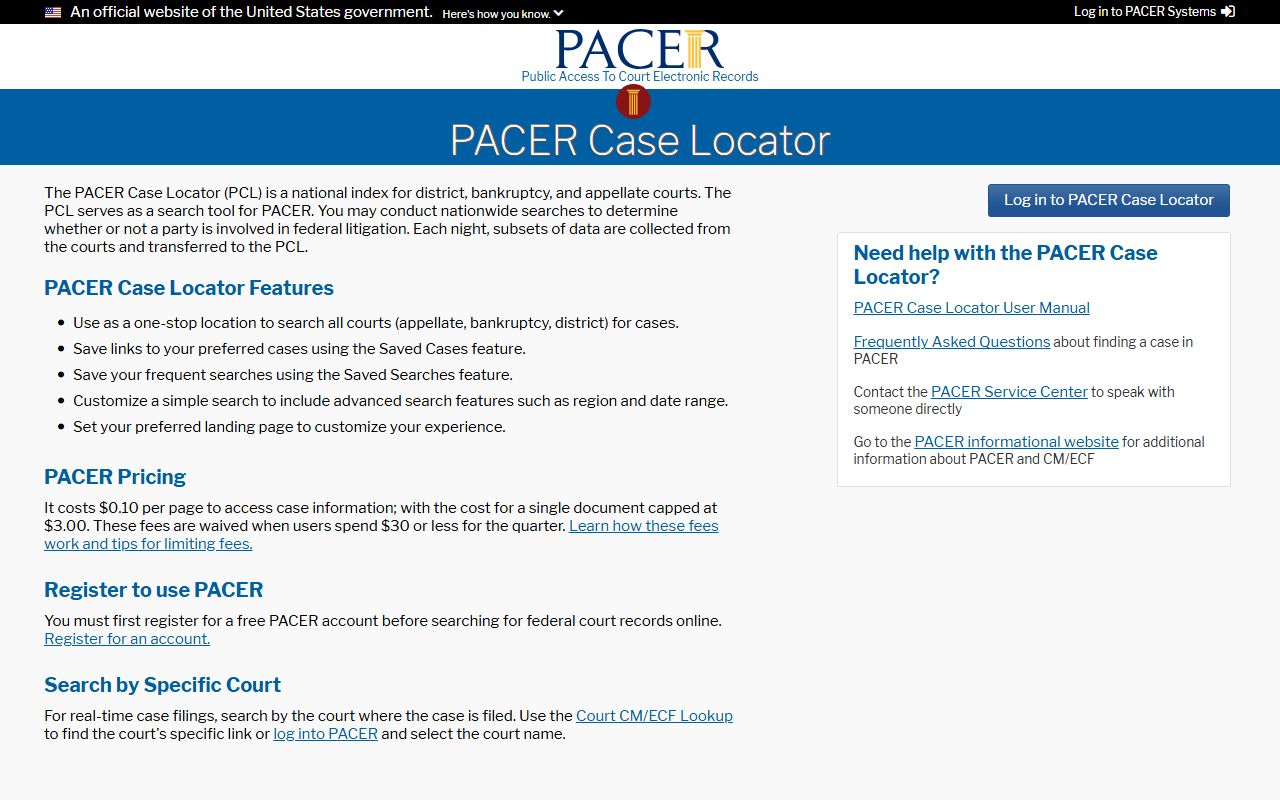
The Case Locator is the fastest way to find a case when you have only a name. It runs fresh each night.
The court also runs the CM/ECF system. This is the same tool lawyers use to file papers. It shows real-time dockets and images of filings. To use CM/ECF, go to ecf.deb.uscourts.gov.
Need help with what the systems can do? The court's Case Information page is a plain-English guide to CM/ECF, VCIS, and PACER. VCIS is the voice system at 866-222-8029 where you punch in numbers on a phone to hear case data. See the case information page for step by step notes.
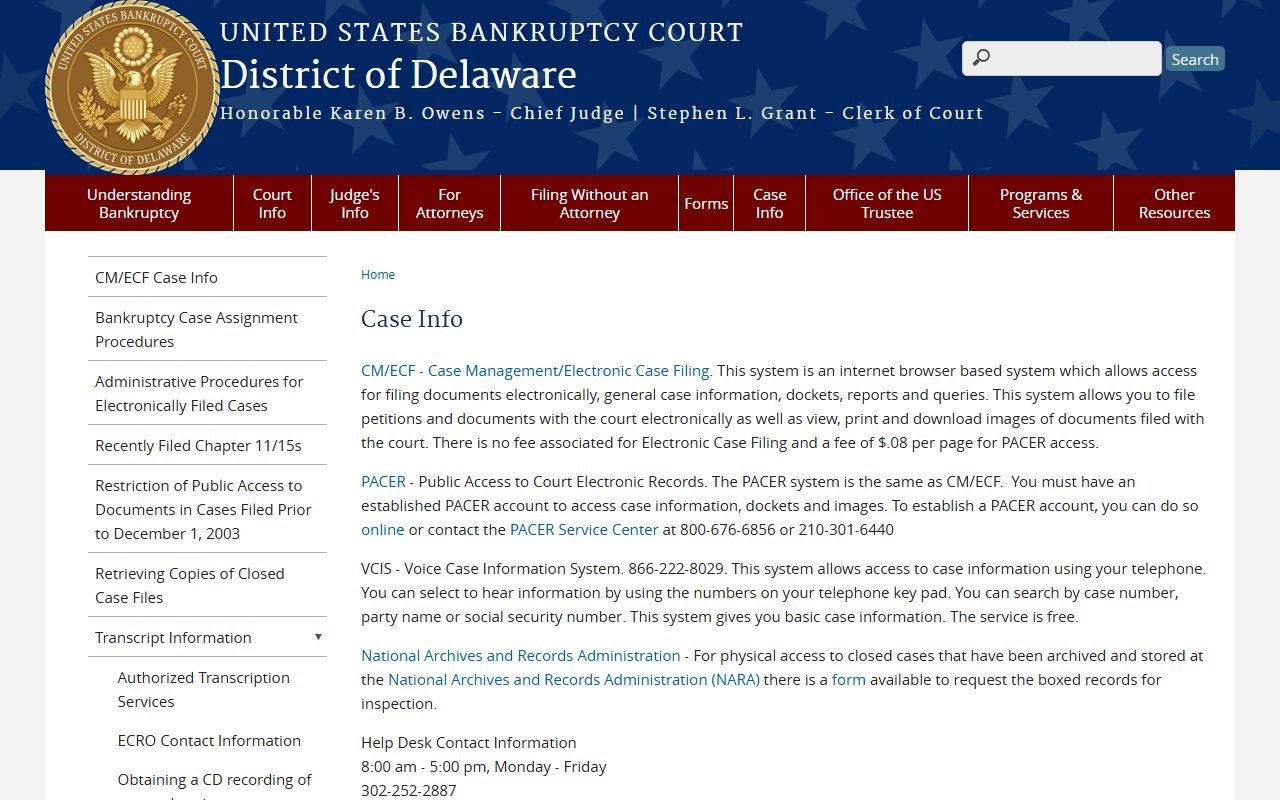
The page lists each tool, what it costs, and what you get. It is the best map to the court's data.
Delaware Bankruptcy Records Fees
The court charges set fees for filings, motions, and copies. The full list is in the official fee schedule, which took effect December 1, 2023. Some key fees to know:
- Motion to Sever (Chapter 7): $338
- Motion to Sever (Chapter 11): $1,738
- Motion to Redact: $28
- Adversary Complaint: $350
- Appeal: $298
- Search fee for closed case file info: $34
- Archive retrieval: $70 first box, $43 each more
PACER fees are different from court fees. You pay $0.10 per page to view docket text or images. A single doc caps at $3.00. If your yearly PACER use stays under $30, the fees get waived. If you need a certified copy from the court, the clerk can make one for a small fee. The clerk takes cash, money orders, and cashier's checks from debtors. From all others, the clerk takes personal checks, debit, and credit cards too. See the full fee schedule for more detail.
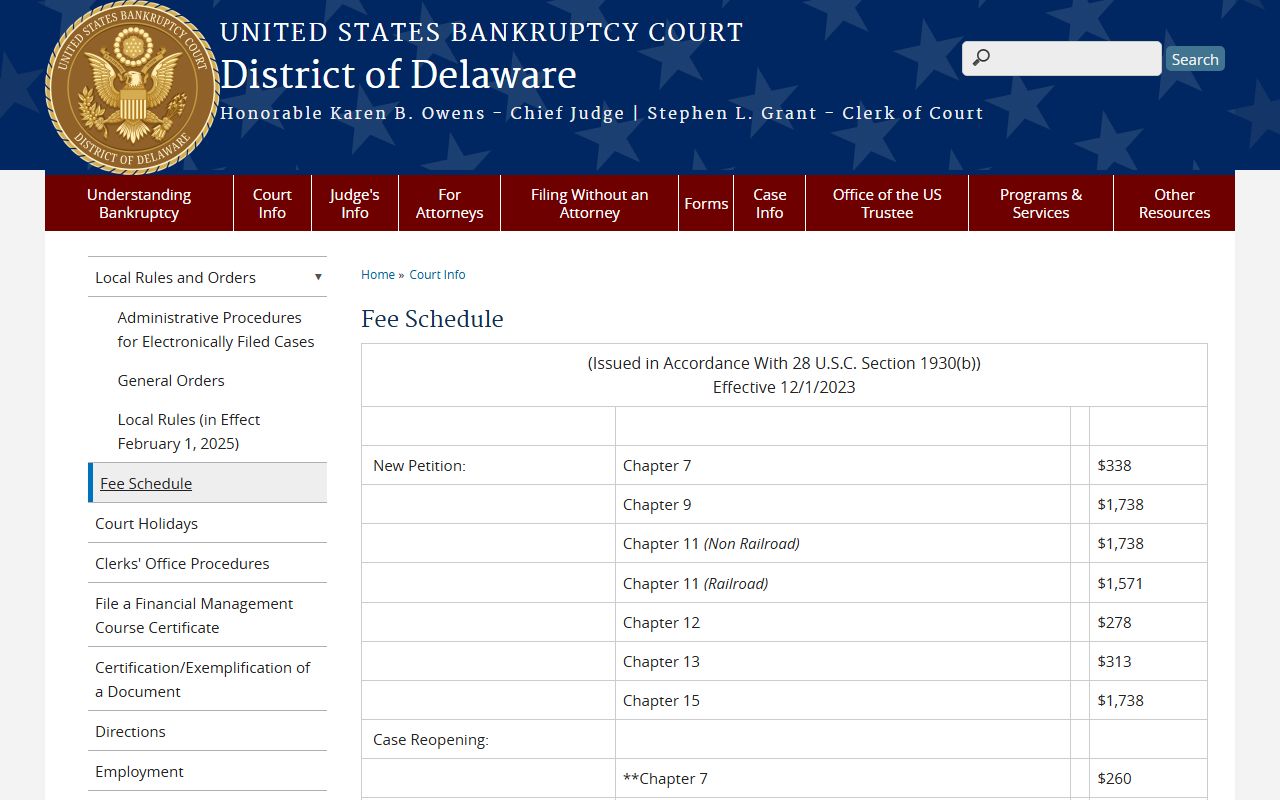
The fee chart is set by 28 U.S.C. § 1930(b). Rates can change, so check the page before you file or pay.
Note: Debtors cannot pay with personal check or credit card. Use cash, a money order, or a cashier's check when you pay the court direct.
Forms and Local Rules
Filing a bankruptcy case means using the right forms. There are three kinds: Official Forms, Procedural Forms, and Local Forms. Official Forms are set by the U.S. courts and must be used. Local Forms are set by the Board of Judges for the District of Delaware. If a local form is marked as required, you must use it or your case could be held up.
The court posts every form on its site. You can grab the 341 Notice, the Ancillary Summons, the fee installment form for Chapters 7, 11, and 13, the proof of claim, the default form, and more. To see the full list, go to the court's forms overview.
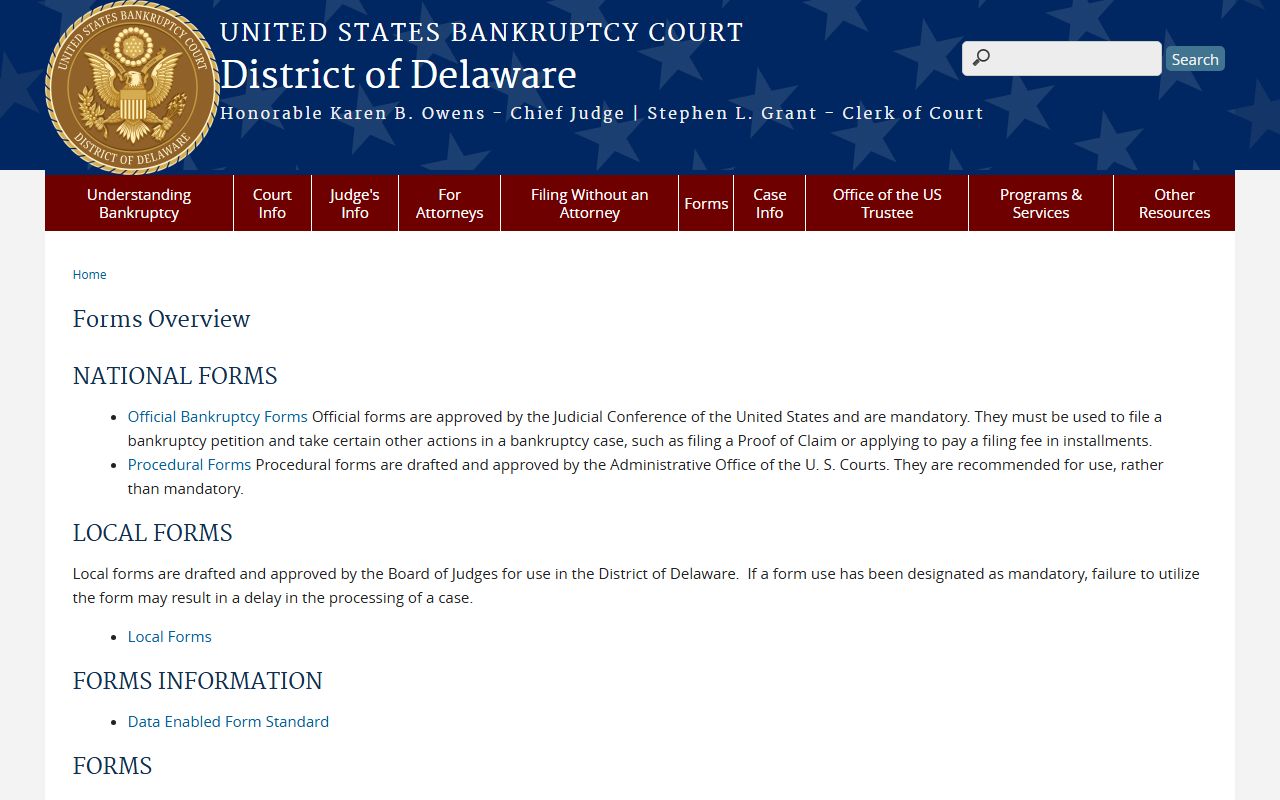
The page splits forms by type and tells you which are needed. It links each form as a PDF.
The Local Rules of the District of Delaware took effect February 1, 2025. They govern practice in all cases filed here. The rules cover plans, motions, claims, disclosure statements, subchapter V cases, and more. If you want to file or respond to a motion, you should read the rule tied to it first. The rules live at deb.uscourts.gov/local-rules.
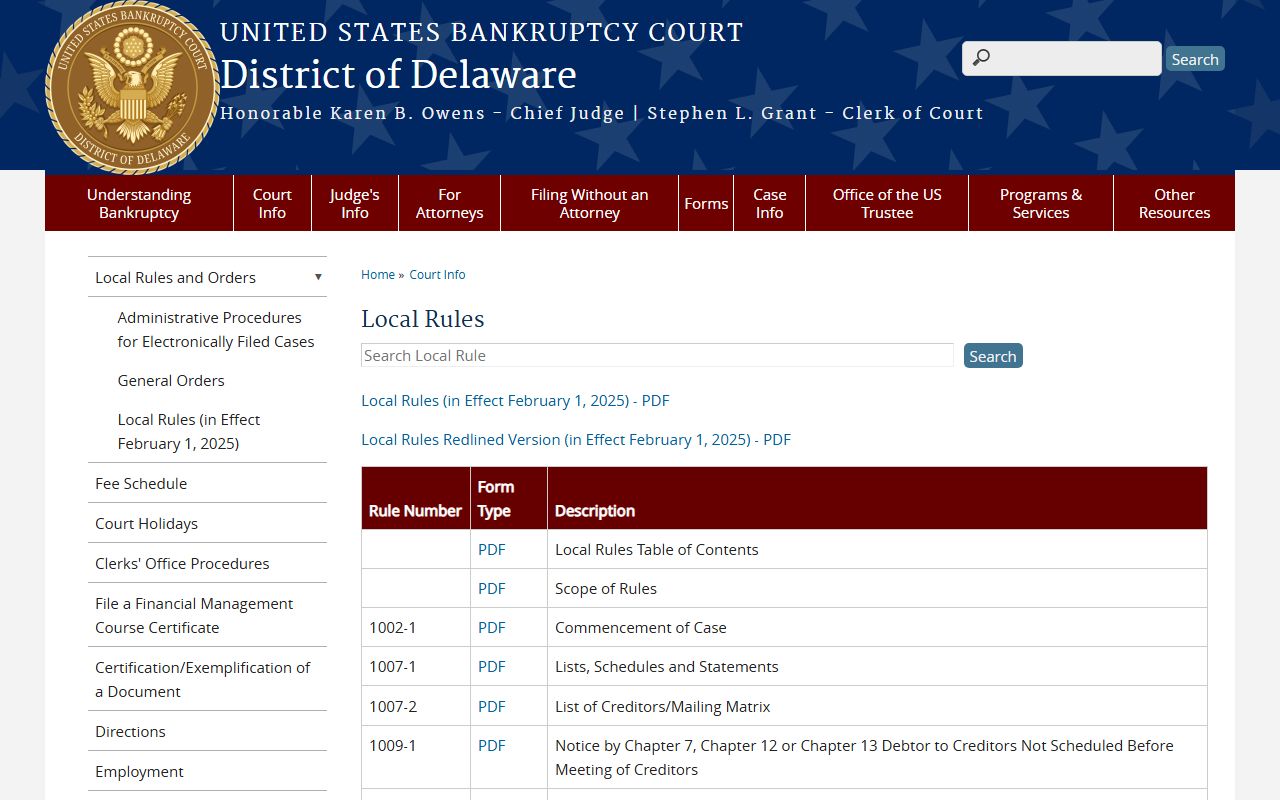
The Local Rules Committee takes public comment at debml_Local_Rules@deb.uscourts.gov. Suggest changes if you spot gaps.
Types of Delaware Bankruptcy Records by Chapter
Bankruptcy cases come in a few types, each called a chapter of Title 11. The kind of case sets the rules, the fees, and what the debtor must do. Delaware bankruptcy records fall under these chapters:
Chapter 7 is the most common. It is a straight bankruptcy where a trustee sells non-exempt assets to pay creditors. Most consumer cases are Chapter 7. In Delaware, Chapter 7 cases are split at random between Judge Shannon and Judge Silverstein. Chapter 11 is for firms and for some people with large debts. It lets the debtor stay in control and work out a plan to pay back creditors over time. Chapter 13 is for wage earners who want to keep their home or car. The debtor pays back some or all debts over three to five years.
Chapter 12 is for family farmers and fishermen. Chapter 9 is for cities and towns. Chapter 15 is for cross-border cases where a firm has debt in more than one country. Title 11 of the U.S. Code lays out all of these rules. Read the full law at govinfo.gov.
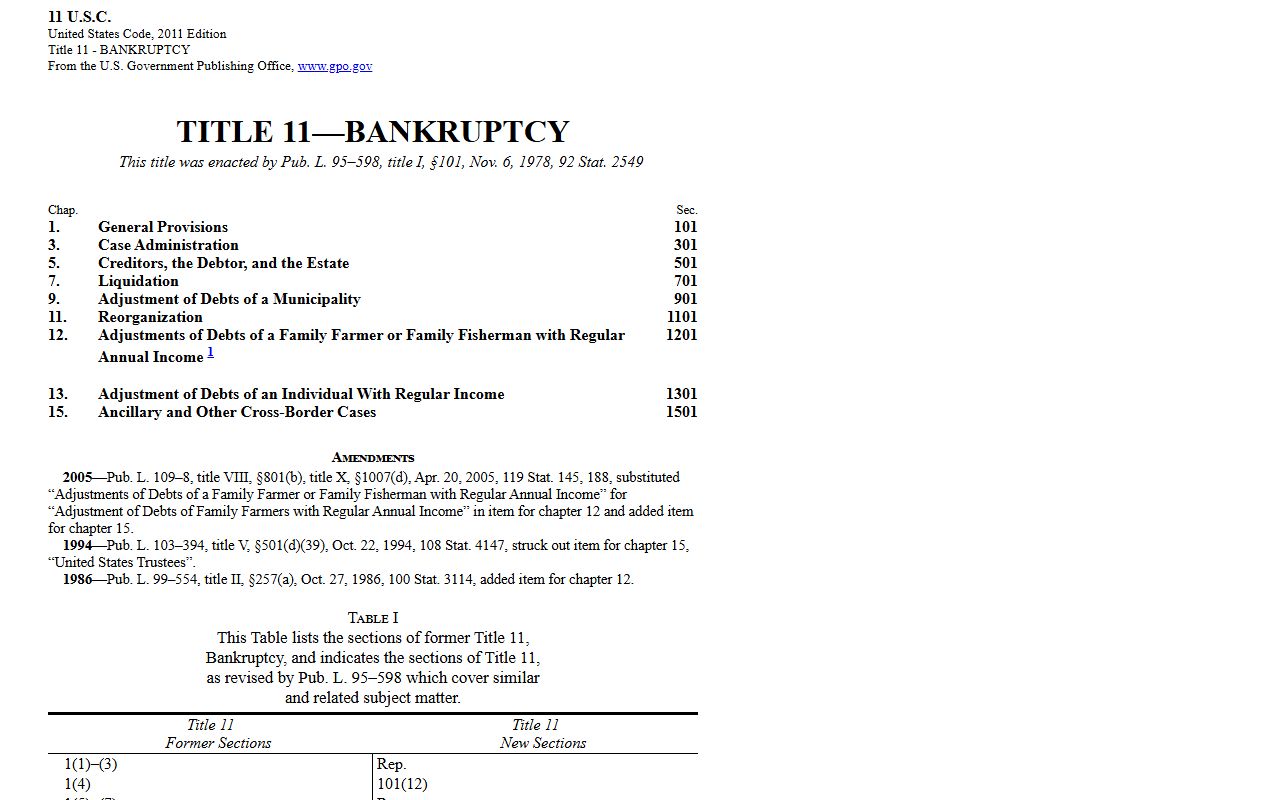
Title 11 has nine chapters. The key ones are 1, 3, 5, 7, 11, 12, 13, and 15. Chapters 1, 3, and 5 apply in all cases.
For a plain-English guide to Chapter 11, see the U.S. Courts Bankruptcy Basics page. The court charges a $1,167 case filing fee and a $571 admin fee for Chapter 11, payable in up to four installments within 120 days.
Judges and Court Contacts
There are eight bankruptcy judges in the District of Delaware. Each judge has their own chambers rules. Those rules set how you bring motions, what times the court holds hearings, and how you ask for a chambers copy. Before you file, check the judge page.
Chief Judge Karen B. Owens sits in Courtroom #3 on the 6th floor. Judge Thomas M. Horan sits in Courtroom #1 on the 6th floor. The other judges are John T. Dorsey, Craig T. Goldblatt, Brendan L. Shannon, Laurie Selber Silverstein, J. Kate Stickles, and Mary F. Walrath. Each judge has an ECRO contact for transcripts. For Judge Dorsey, that is J. Cooper at 302-252-2859. For Judge Owens, K. Ross at 302-252-2891. For Judge Silverstein, B. McCarthy at 302-252-2906. The judge information page has the full list.
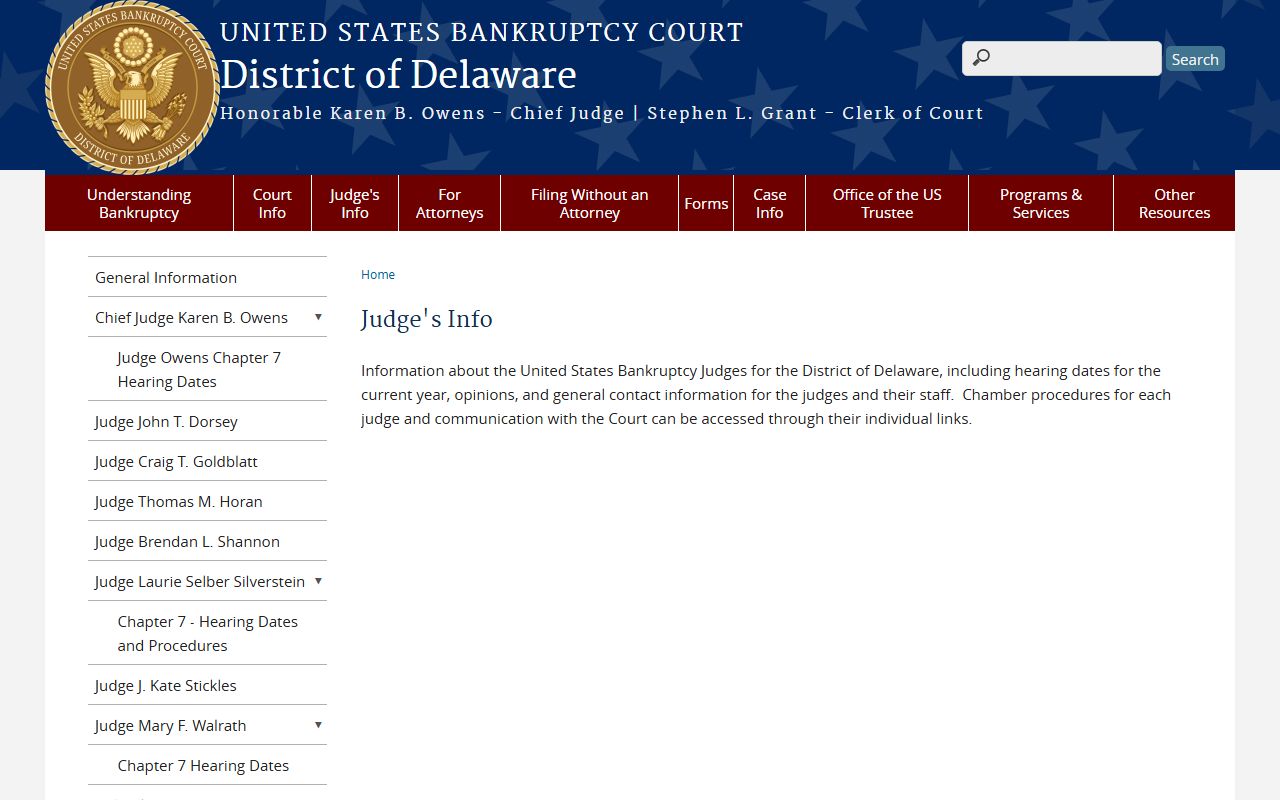
The page links each judge to their own rules, hearings, and opinions. Check the judge page before every filing.
Closed Cases and Archived Files
The court keeps case files for 15 years. Older closed case files go to the National Archives and Records Administration in Philadelphia. To pull an archived case, you first need the FRC info from the court. That means the transfer number, the location number, the box number, the case name, and the case number. The clerk cannot give that out over the phone.
You mail a search request to the clerk's office. Pay $34.00 per case in a money order, cashier's check, exact cash, or attorney's check. Personal checks do not work. Once you have the archive info, NARA charges $70 for the first box and $43 for each more box. For help in a rush, call the clerk's office at 302-252-2900. Steps are on the closed case retrieval page.
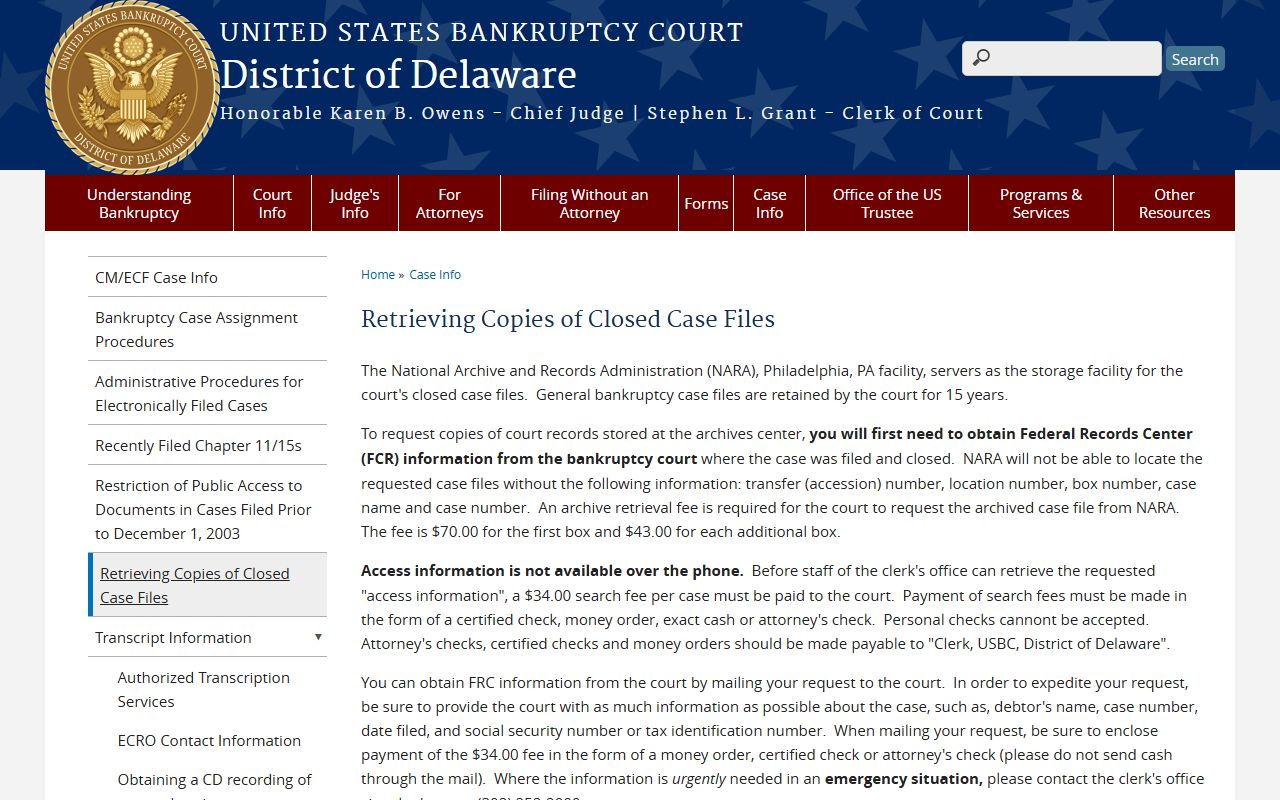
The page lays out each step and each fee. Send as much case info as you have to speed the search.
Cases filed before December 30, 2002, may still be viewable at the court in Wilmington, but document images may not be in PACER. Older records may need a trip to NARA in Philadelphia.
Legal Help and Attorney Resources
Filing a case without a lawyer is allowed, but most people use one. The court has a help desk for basic questions, but staff cannot give legal advice. For free or low-cost help, check the legal aid groups serving Delaware. Community Legal Aid Society, Inc. helps low-income folks in New Castle, Kent, and Sussex counties. Delaware Volunteer Legal Services helps New Castle County at 302-575-0660.
The Delaware State Bar Association has a Lawyer Referral Service at courts.delaware.gov links. The State Bar can set you up with a lawyer who does bankruptcy work. Most lawyers who file in Wilmington are admitted to the U.S. Bankruptcy Court for the District of Delaware.
Tip: Free or sliding-scale help may be out there if your income is low. Call a legal aid group first before you pay a private lawyer out of pocket.
State Agencies and Delaware Bankruptcy Records
The Delaware Division of Revenue is a key state office for tax matters in bankruptcy. If you owe state taxes, this office can tell you the amount, the type, and the split between tax, penalty, and interest. You need this data for Schedule E/F of your petition.
The Division has three offices: New Castle County at 820 N. French Street in Wilmington, 302-577-8200. Kent County at Thomas Collins Building, 540 S. DuPont Highway in Dover, 302-744-1085. Sussex County at 20653 DuPont Blvd. Suite 2 in Georgetown, 302-856-5358. All are open 8:00 am to 4:00 pm. See the Division of Revenue bankruptcy page for more.
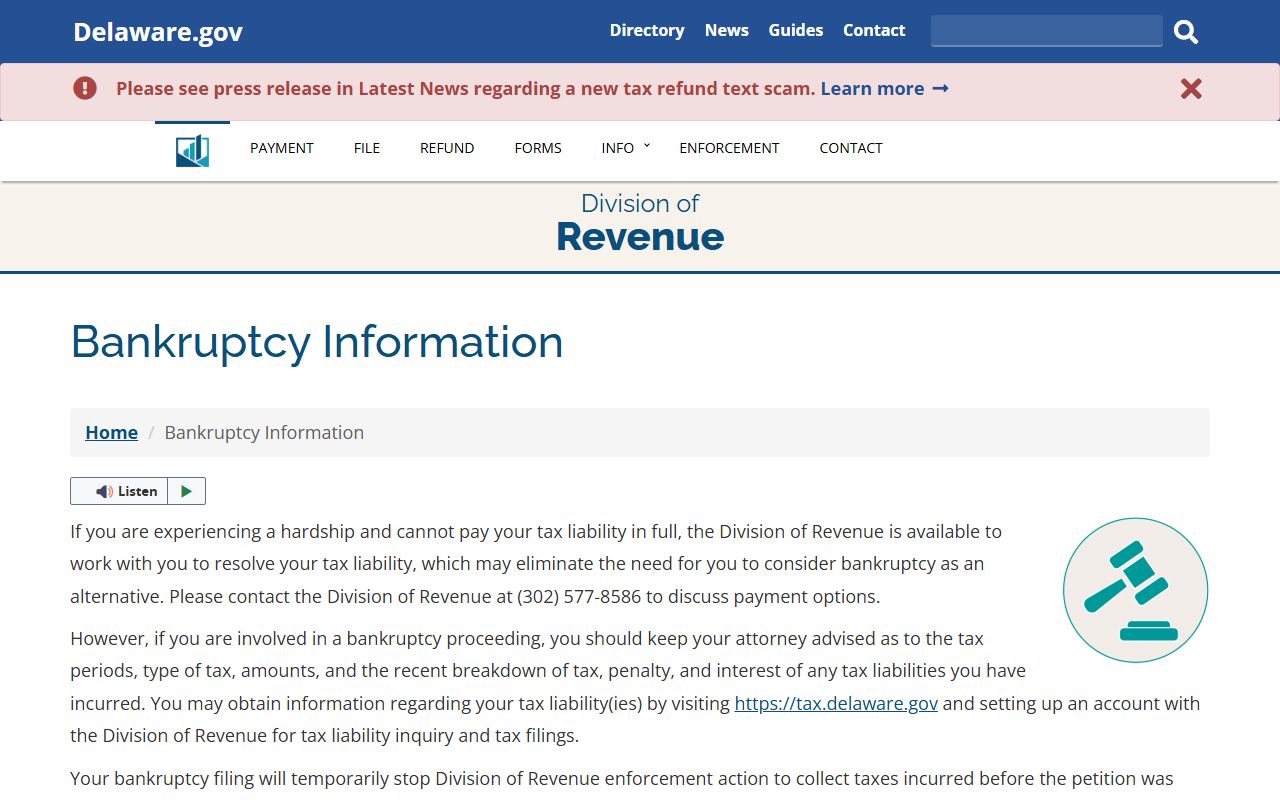
The page tells you how to ask for tax account info, how a case stops collection, and what to do about post-filing taxes.
A bankruptcy filing will pause state tax collection on pre-filing debt. You still have to file returns and pay any taxes that come due after you file. Some tax debts cannot be wiped out, so talk to a lawyer about what is dischargeable and what is not.
Are Delaware Bankruptcy Records Public
Yes. Under 11 U.S.C. § 107, bankruptcy filings are public records. Any person can view them. No reason or ID is needed in most cases. You can view them at the courthouse in Wilmington or online through PACER.
Some parts get sealed. The court can seal trade secrets, personal data, and some child-related files. Full Social Security numbers, bank account numbers, and the names of minors are redacted by rule. A party can ask the judge to seal more, but that is not common. The court weighs the right to know against the need for privacy.
For a broader look at Delaware court records, see Delaware court records info. It explains how the court system is built and how to pull records across state and federal courts.
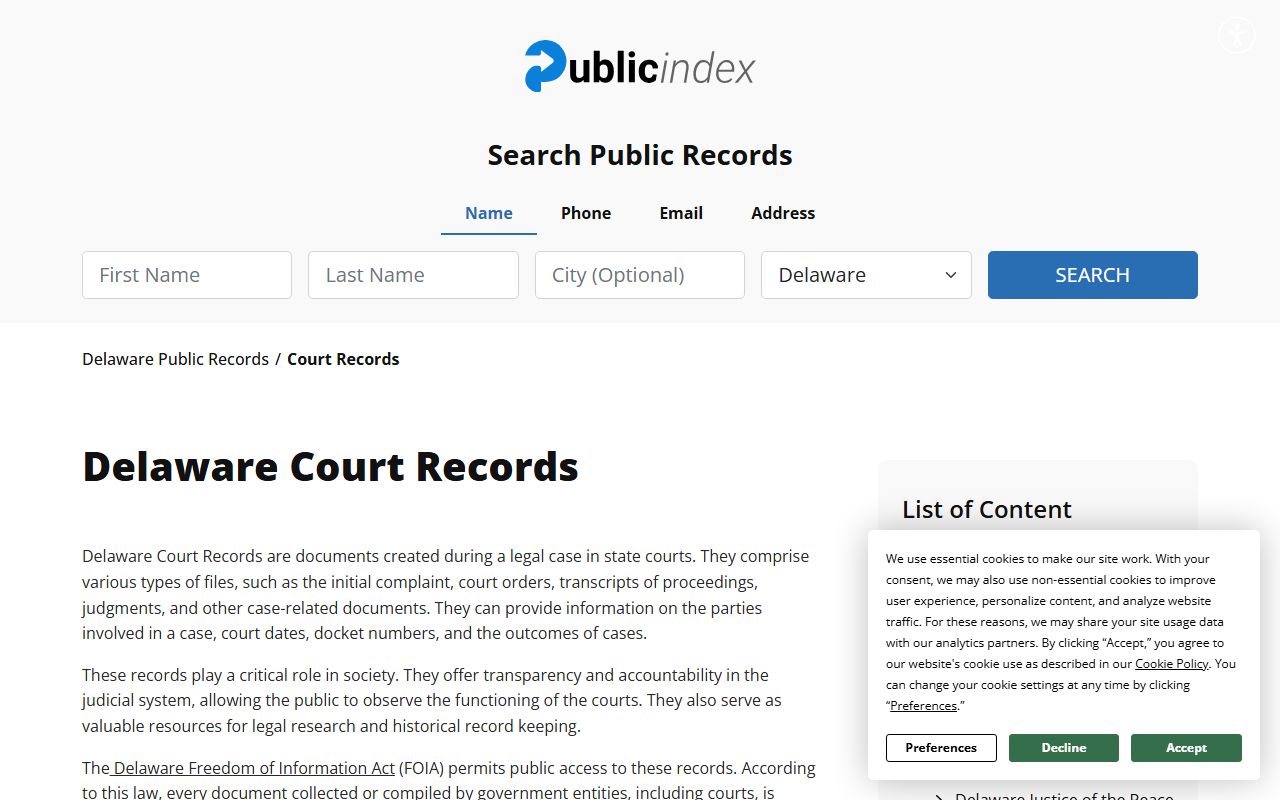
The page lists what a bankruptcy record holds: debtor name, filing date, chapter, creditors, and more.
Corporate and Chapter 11 Cases
Delaware is the top venue in the U.S. for large Chapter 11 cases. Many major U.S. firms are set up as Delaware corporations. That makes it easy to file here. The court has deep roots in complex reorganizations. Past cases include FTX Trading Ltd., Live Well Financial, TE Holdings Management, Model Dental Office, BL Acquisition Corp., and many more.
Outside aggregators track Delaware cases too. UniCourt lets you search Delaware bankruptcy cases by type, including Chapter 7, 9, 11, 12, 13, and 15. You can pull docket info, case status, and alerts on new filings. Use it as a second-source look to go with PACER.
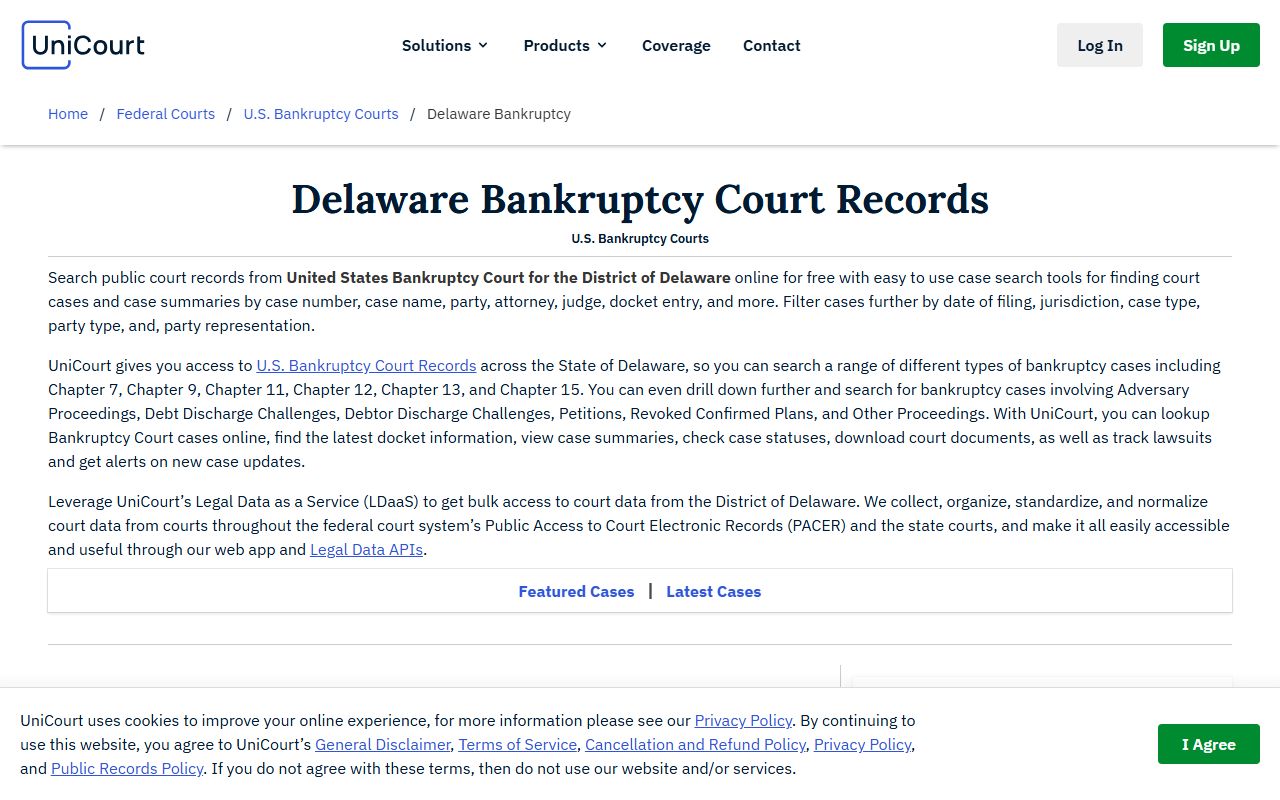
UniCourt pulls data from court feeds. The site is free to browse and paid for deep access.
Browse Delaware Bankruptcy Records by County
Pick a county below for local info. Each page lists the state court seat, the Division of Revenue office, and legal aid near you. Remember, all cases are filed in Wilmington, no matter which county you live in.
Bankruptcy Records in Major Delaware Cities
Find local city info here. Each page covers the closest court, legal aid, and help for that spot. All filings still go to the Wilmington court.